Our Location
304 North Cardinal St.
Dorchester Center, MA 02124

304 North Cardinal St.
Dorchester Center, MA 02124
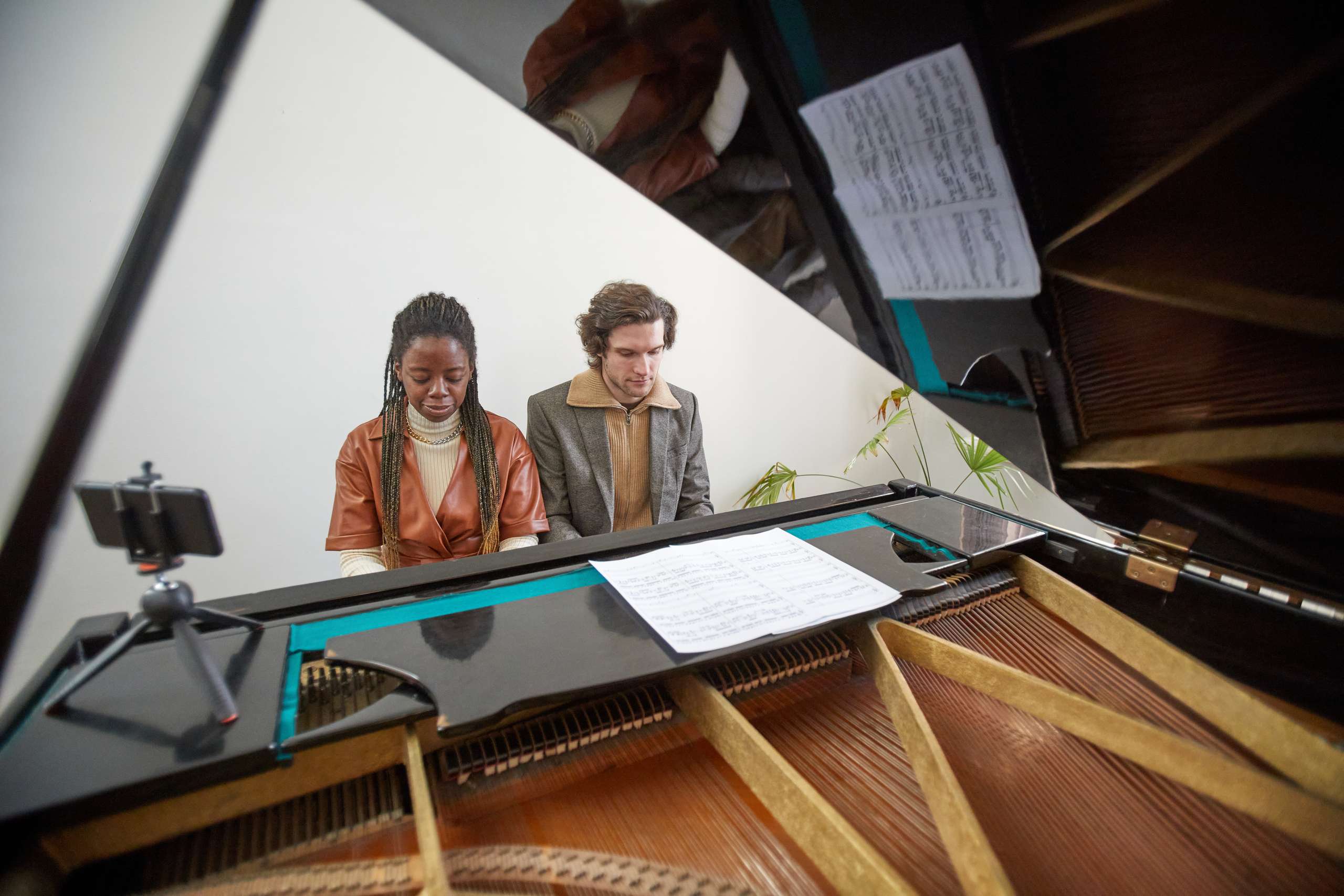
When it comes to playing the piano expressively, mastering technique is crucial, but it’s not the only requirement. Sure, having good technique is important — it enables you to play the right notes, control dynamics, and achieve a range of tonal variations. However, it doesn’t necessarily make you expressive. Think of technique as the tool and expression as the manner in which you use that tool. To convey emotion through your playing, you need to know how to expressively manipulate the tool itself.
Most piano students spend the majority of their time practicing technical studies and repertoire with the assumption that if they can just play the right notes at a faster tempo, the music will sound good. Of course, technique is a crucial part of playing the piano. It’s impossible to play musically without it. But technique alone will only bring you so far. The most impeccable playing without any musical direction will sound like an android playing the piano. To take your playing to the next level, you need to have a musical idea driving your technical practice.
We think expressive playing starts with the nature of the music. Music has a certain emotional feel to it due to the harmony, rhythm, and form. The emotional feel of music cannot be expressed through playing the right notes alone; the player has to have an idea of when there is more tension, when the music has more time to expand, and how different themes are connected. This requires an inner ear and an imagination, not just finger dexterity. If the pianist can imagine an emotional arch of the music, I think the finer details of finger pressure and phrasing will be mostly taken care of.
There’s also the matter of tone. The piano is an instrument on which you don’t just play the “right” notes, you also have to play them a certain way. The force with which you push the keys down, the speed with which they are pushed, the amount of weight in your arm, the synchronization of your fingers, etc., all affect the sound that you produce. You could play the same section two times and have it sound warm and full one time and bright and sharp another time, just based on the physical way in which you’re playing. The way to cultivate this sensitivity is to practice very, very slowly, while focusing carefully on the sound you are producing, rather than the speed at which you’re playing. This forces you to think of each note as an event, rather than just something that you’re doing on the way to the next thing.
Another factor in expressiveness is flexibility of tempo, which is known as rubato. While it is important to be in-time according to a metronome, it is also necessary to expand and shorten tempo in order to give a feeling of a natural tempo. This imparts a feeling of improvisation, a sense that the performer is not just playing from memory but is making the music up on the spot. Taste in using tempo in this way can be learned from the traditions of different styles of music, but it also requires the performer to follow their gut musical instincts, which is something that also takes time to develop.
In fact, technique and expression are far from being mutually exclusive. One enables the other. Without the control to execute the will of an interpretation, there is no technique; without something to say that necessitates the mastery of technique, there is no expression. And when the two are working together, the piano stops sounding like a collection of keys struck by fingers, and starts sounding like a language. The audience stops hearing notes played and starts hearing drama and resolution and storytelling. So the end of piano study isn’t finger control, but the illusion of sound that has a beating heart.